


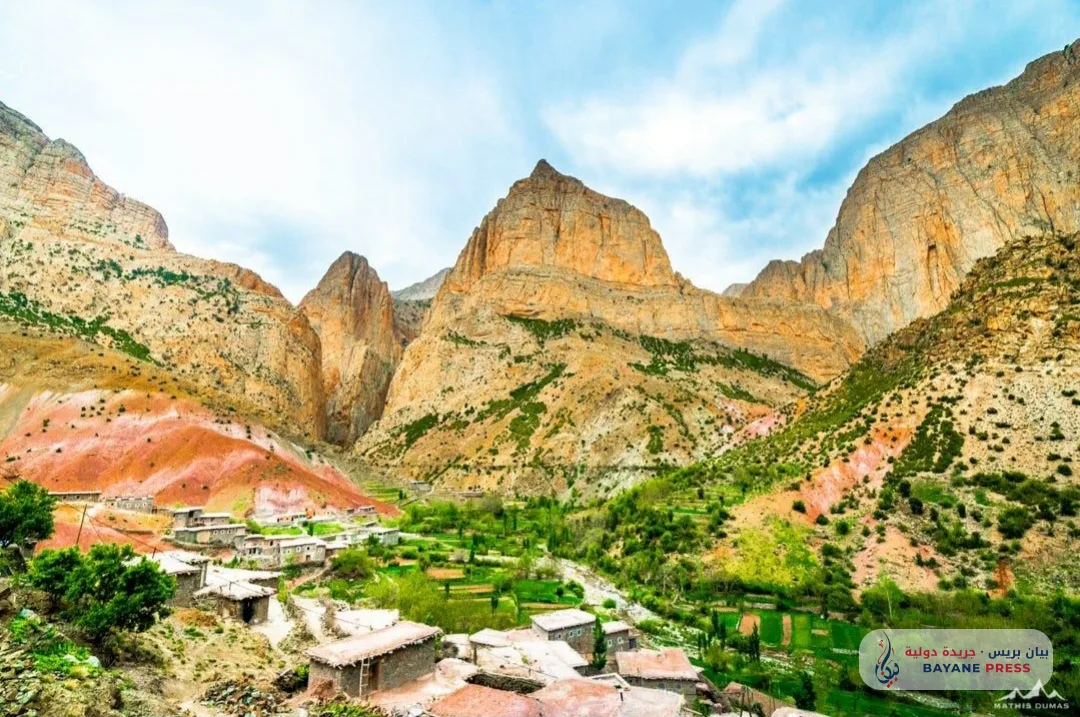
Deep in the heart of the Central High Atlas, where roads bow before the majesty of the mountains and small villages hide behind towering peaks, lies one of Morocco's most magnificent natural treasures. It is the village of Taghia, a charming mountain gem whose fame was not built by luxury hotels or modern resorts, but by nature itself over millions of years. Nature carved the rocks, opened the gorges, and cut water channels between the mountains, leaving humanity a rare canvas where the grandeur of the terrain embraces the simplicity of authentic Amazigh life.
Taghia, also spelled "Tagia," is located within the jurisdiction of the Zaouiat Ahansal commune in the Azilal province, part of the Béni Mellal-Khénifra region, at an altitude of nearly 1900 meters above sea level. It is a small mountain village nestled in the lap of a massive rock formation resembling a natural amphitheater, surrounded by towering limestone walls, deep canyons, narrow passages, and fresh water springs. It is a scene that makes the visitor feel as though they have entered a different world, far from the bustle of cities and the noise of daily life.
The most exciting aspect of Taghia is the beautiful contrast between the harshness of the rocks and the softness of nature. While rocky cliffs rise hundreds of meters, small green spaces, terraced agricultural fields, and fruit trees nourished by mountain water spread at their feet. Traditional houses built of stone and earth blend in color with the surrounding rock formations. When the sun rises, the mountain faces transform into enchanting gradients of gold, red, and copper, before the evening shadows descend, making the village look like a painting created by nature, untouched by an artist's brush.
Perhaps the first thing that distinguishes this village is that reaching it is a tourist adventure in itself. The journey usually begins from Marrakech or Béni Mellal, passing through the city of Azilal, then heading towards Zaouiat Ahansal via mountain roads that reveal to the visitor successive scenes of valleys, highlands, and Amazigh villages. Zaouiat Ahansal is about 250 kilometers from Marrakech via established land routes, with the distance varying depending on the chosen path, before reaching the most thrilling stage of the journey.
From the Zaouiat Ahansal area, the visitor continues towards Taghia via mountain trails. The final leg often takes between two and three hours on foot, depending on the starting point, physical fitness, and trail conditions. One can hire locals to transport luggage using mules, a mountain tradition that remains part of the residents' lives and means of transport. Despite the appearance of some dirt tracks accessible by suitable vehicles under certain conditions, Taghia remains a destination that requires prior planning, and one should not assume that all its facilities are accessible by a standard tourist car.
During this path, the splendor of the place is revealed gradually; the traveler crosses water streams and small fields, passing alongside massive rocks that rise above their heads, before the mountains open up to a majestic panoramic view, in the heart of which appears the village of Taghia, surrounded by what look like natural fortresses. At this moment, the visitor realizes that the hardship of the road was merely a prelude to a visual reward that is hard to forget.
The rocky gorges hold an exceptional place among the region's landmarks, led by the Taghia gorges, the Tafraout gorges, and the Tazaght valley, which are natural passages carved by water through layers of limestone over long geological eras. These gorges are characterized by towering vertical walls and canyons where light only reaches the depths during limited hours of the day, giving them a mysterious beauty that attracts photography, adventure, and exploration enthusiasts.
Among the most famous mountain formations overlooking the village is Jebel Oujdad, which reaches an altitude of about 2706 meters and forms a massive rock mass that rises majestically in the natural landscape, in addition to the cliffs of Taoujdad, Timrazine, and other walls that have become known to rock climbers. These formations are surrounded by high limestone plateaus, with large parts ranging in height between 2500 and over 3000 meters, characterized by their rugged terrain and intricate natural paths.
The value of these mountains is not limited to their beautiful scenery; they also represent an open geological record that tells part of the history of the formation of the Moroccan Atlas. The limestone layers and sedimentary rocks that appear on the cliff faces bear traces of ancient geological transformations, while the canyons and fissures reveal the immense power exerted by water and erosion over millions of years. The region is characterized by karst formations that allow water to seep into the interior of the rocks before reappearing as springs at the base of the cliffs, contributing to feeding the sources of the Ahansal Valley.
These natural characteristics have given Taghia a prominent place among global destinations for rock climbing, becoming a destination for professional climbers from different countries looking for long and difficult routes amidst limestone cliffs, some of whose faces exceed hundreds of meters. The region is famous for what is known as multi-pitch climbing, where the athlete needs to cross several consecutive sections to reach the top of the rock wall, using ropes, safety equipment, and specialized techniques.
Climbing routes in Taghia vary between partially equipped routes and those requiring additional protection, and they differ in difficulty and length. Over the decades, Moroccan and foreign climbers have contributed to exploring and documenting many of these routes, giving the village a remarkable presence in international circles interested in mountain sports. However, climbing the major cliffs is not suitable for beginners without proper guidance, given the ruggedness of the terrain and the difficulty of rescue operations in remote areas.
One of the most astonishing landmarks is what is known as the "Amazigh Path," a traditional route carved or fixed in some sections on the sides of rocky cliffs using stones and wood, reflecting the mountain inhabitants' knowledge of their region's terrain and their ability to innovate means of movement through places that seem at first glance impassable. This path stands as a testament to the Amazigh human's relationship with their environment and the skill, patience, and adaptation to nature that mountain life required. However, crossing it, in the exposed and dangerous sections, requires experience and qualified accompaniment, and it should not be treated as an ordinary tourist path.
Beyond adventure sports, Taghia offers its visitors an exceptional opportunity for mountain hiking, nature contemplation, and photography. The trails surrounding the village vary between short walks near fields and springs, and longer trips towards the gorges, plateaus, and neighboring peaks. The visitor can choose a path that suits their physical abilities, with the help of a local guide who knows the nature of the region, weather changes, and safe passages.
But the charm of Taghia is not limited to its exceptional terrain; the village retains the spirit of Amazigh mountain life, where residents are connected to the land, small-scale farming, livestock breeding, and local services related to tourism. In the narrow fields surrounded by mountains, the human ability to invest in limited spaces and spring water is evident, while traditional houses and simple alleys form an authentic part of the place's identity.
Hospitality holds an important place in the tourist experience in the village, as some families provide guesthouses and mountain shelters that welcome climbers and nature lovers. These accommodations are characterized by their family nature and quiet atmosphere, far from the usual manifestations of tourist luxury. There, the visitor can enjoy traditional Moroccan dishes, such as tagine, couscous, and local bread, along with Moroccan tea, which gains a special taste after hours of walking in the mountains.
Mountain tourism has contributed to creating additional economic opportunities for some of Taghia's residents through accommodation, guiding, luggage transport, meal preparation, and trip-related services. These activities gain special importance in a region facing challenges related to isolation, difficult terrain, and limited infrastructure, which makes developing responsible tourism an opportunity to support the local economy, provided that a balance is maintained between welcoming visitors and preserving the natural environment and the community's privacy.
As for the climate, Taghia is characterized by mountain weather that changes clearly from one season to another. Spring, especially from April to June, is one of the suitable periods to visit, when fields and valleys are covered in green and temperatures become more suitable for walking and climbing. Autumn, particularly September and October, also provides good conditions for mountain activity lovers and photography, with seasonal colors adding extra beauty to nature.
In summer, temperatures may rise on cliffs exposed to the sun, despite the village's mountain altitude, while winter is sometimes very cold, with the possibility of snow on the heights and difficulty in some paths. Sudden weather changes, especially thunderstorms and rising water levels inside narrow gorges, remain risks that require caution, even during periods that seem suitable for tourism.
Therefore, it is advised that the visitor prepare well before heading to Taghia by choosing suitable shoes for mountain walking, carrying clothing appropriate for weather fluctuations, water, and essential materials, and ensuring accommodation and transport arrangements in advance. One should also not rely entirely on phone and internet networks, which may be limited in some locations, and refrain from entering gorges or climbing exposed paths in unstable weather conditions.
A visit to Taghia gains another dimension when it is part of a trip to discover the wider natural area of the Azilal province. The region includes distinct destinations, including Zaouiat Ahansal with its historical and spiritual heritage linked to the saint Sidi Said Ahansal, the Ahansal Valley with its mountain views, the Imsfrane rock formation known as "The Cathedral," as well as the Ait Bouguemez Valley, famous for its meadows, agricultural terraces, and the view of the surrounding peaks. Together, these sites allow for the discovery of exceptional natural and cultural diversity within the Central High Atlas.
In Zaouiat Ahansal, the visitor can learn about some features of traditional mountain architecture and the specificity of Amazigh residential clusters that grew up around valleys, pastures, and ancient paths. The region gains special geological value within the natural area of the M'Goun Global Geopark, which reflects a great diversity of rock formations and natural phenomena in the Central High Atlas.
One cannot talk about Taghia's tourism future without stopping at the issue of environmental conservation. The fragility of the mountain ecosystem, the limited water resources, and the difficulty of waste management in remote areas are all factors that make sustainable tourism a necessity, not just a slogan. This requires encouraging visitors to respect fields and property, not to pollute water streams, to use known paths, and to avoid damaging plants and rock formations, while supporting the services of guides and local guesthouses.
The most prominent development challenge remains finding a balance between breaking the isolation of the residents and preserving the natural privacy that gives the village its appeal. Improving health services, communication means, infrastructure, and mountain safety would benefit both residents and visitors, without requiring the transformation of this unique space into an overcrowded tourist destination that loses its tranquility and authenticity.
Perhaps the most beautiful thing Taghia gives to humans is that rare feeling of liberation from the fast-paced rhythm of life. In the early morning, when the sun's rays begin to touch the rock peaks and the sounds of water flow between the fields, the visitor realizes that the place does not need manifestations of luxury to leave a deep impact on the soul. And when evening comes and the lights withdraw from the giant cliffs, the grandeur of nature is manifested in the silence of the mountains and the vastness of the sky, turning the simplest moments of sitting and contemplation into an experience no less beautiful than the most wonderful trips.
Taghia is not just a small village in the Azilal mountains, nor a passing station for climbing and adventure enthusiasts, but one of those places that remind us that Morocco possesses a tourist wealth that exceeds ancient cities, beaches, and resorts, to include mountain villages that embrace a human and natural heritage of great richness, worthy of discovery, appreciation, and protection.
It is Taghia, where the mountains speak the language of grandeur, the water tells the stories of the earth, and the human gives nature the meaning of hospitality and authenticity. Whoever visits it does not return carrying only beautiful pictures, but returns with a memory full of wonder and a firm conviction that some of Morocco's most beautiful treasures are still hiding in places that are not easily reached by roads, but are reached by hearts with the passion of discovery.


Comments (0)
No comments yet. Be the first to react!