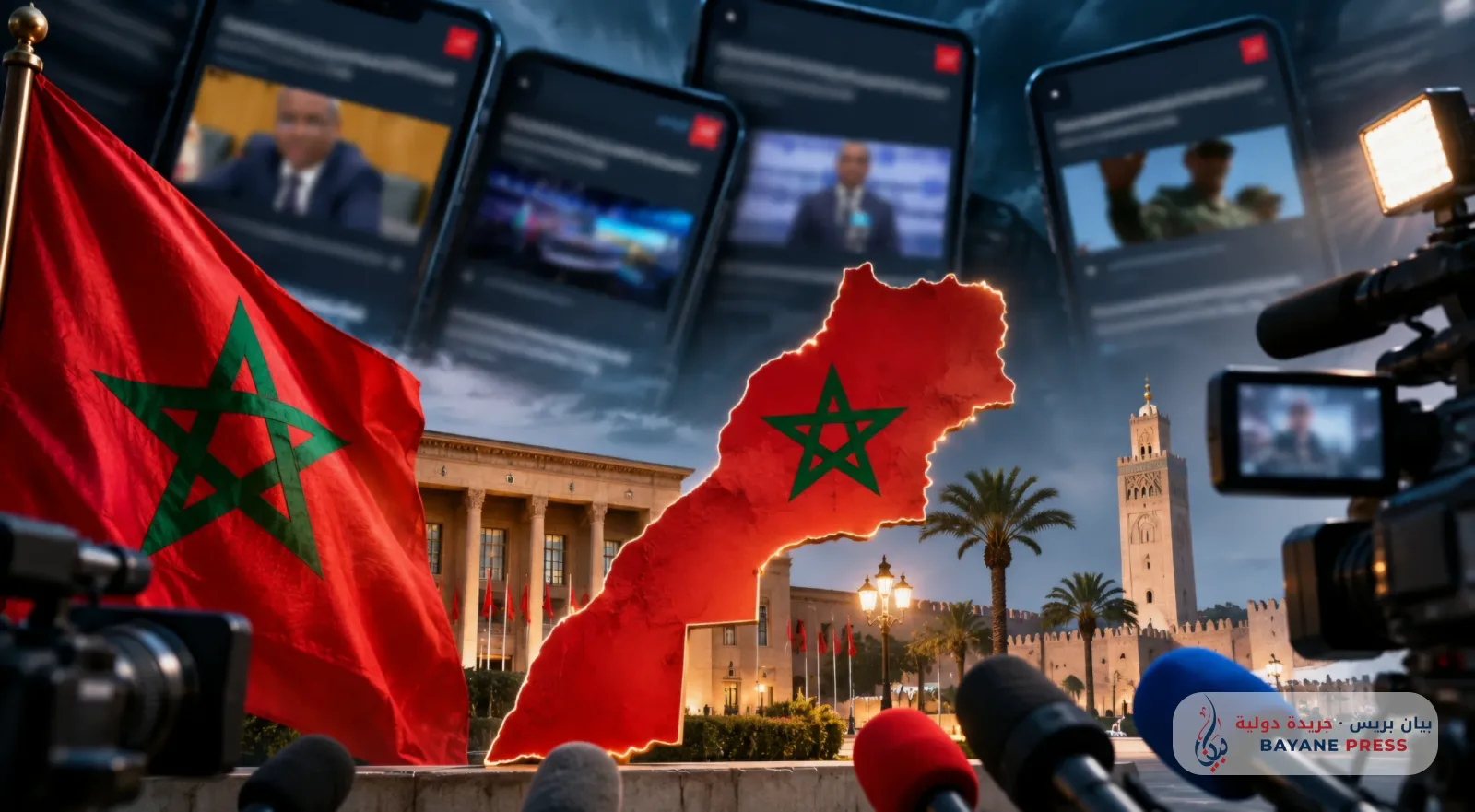
The interest shown by certain Algerian media outlets in Moroccan affairs is no longer mere journalistic coverage of a neighboring country's news; it has begun to raise serious questions about the nature of the media discourse directed at the Kingdom, as its political, diplomatic, and social news have become recurring material for headlines often characterized by selectivity, exaggeration, and accusation. It is noteworthy that this focus is not limited to the issue of the Moroccan Sahara, but extends to the Royal institution, urban development projects, and social conditions, as if Morocco has become present in a segment of the Algerian media landscape from the angle of a constant search for crises and differences, rather than an interest in providing a comprehensive picture of its developments, achievements, and challenges.
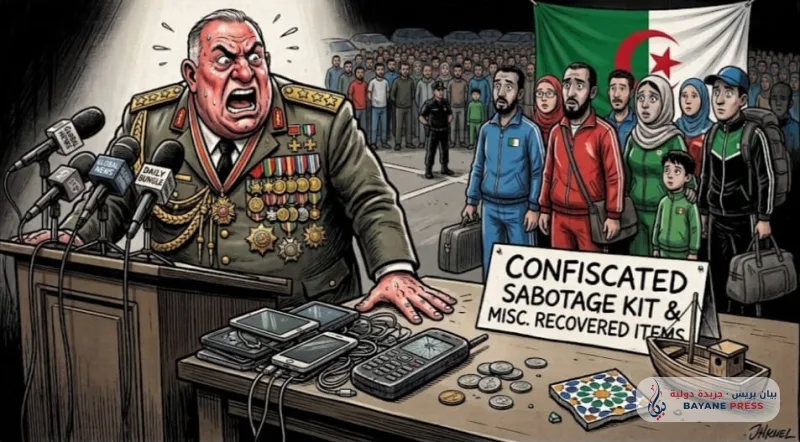
A collection of headlines published on Monday, November 16, 2026, revealed a clear pattern of this trend, as coverage by Algerian media outlets coincided, addressing the Moroccan Sahara, statements attributed to former American officials, accusations issued by the Polisario Front, and news about demolition and urban redevelopment operations in Rabat, as well as an article carrying sharp criticism of the Moroccan Royal institution. This coincidence raises a legitimate question about the reasons for the recurring appetite for negative news, and the extent to which some outlets are committed to distinguishing between reporting facts and utilizing them in the context of the ongoing political dispute between the two countries.
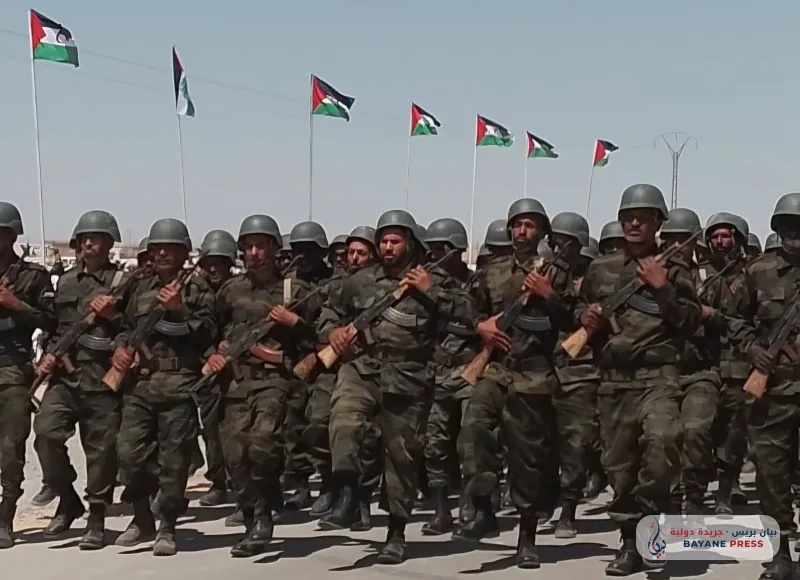
Regarding the Moroccan Sahara, the newspaper "Echorouk News" published a headline discussing American testimonies revealing the reasons for the referendum's stagnation, while in another report, it addressed accusations against Polisario regarding human rights. In the same context, the "Aurès" website published a report about a letter sent by the Front to the United Nations, which carried criticisms of Morocco and its diplomatic positions. However, a closer look at the content of this coverage reveals that a significant part of it is linked to a single political message issued by the Polisario representative to the United Nations, which included recalling old positions and statements by former American officials, including James Baker and John Bolton.
Here, a fundamental observation emerges regarding the way news is manufactured; redistributing the contents of a single political document across several headlines may give the reader the impression of successive and independent developments, while in part, it is about re-presenting previous positions within a new media context. Furthermore, statements by former American officials do not necessarily represent the position of the current US administration, and they cannot be presented as a new official shift in American policy without the existence of decisions or statements confirming this.
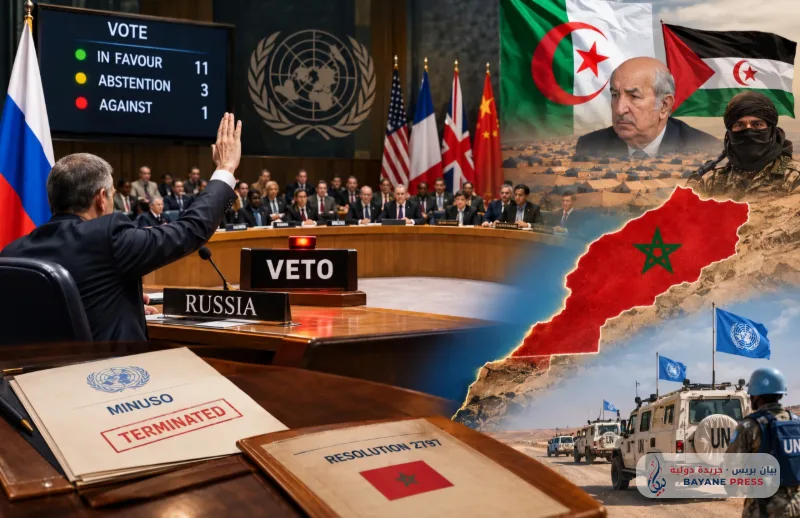
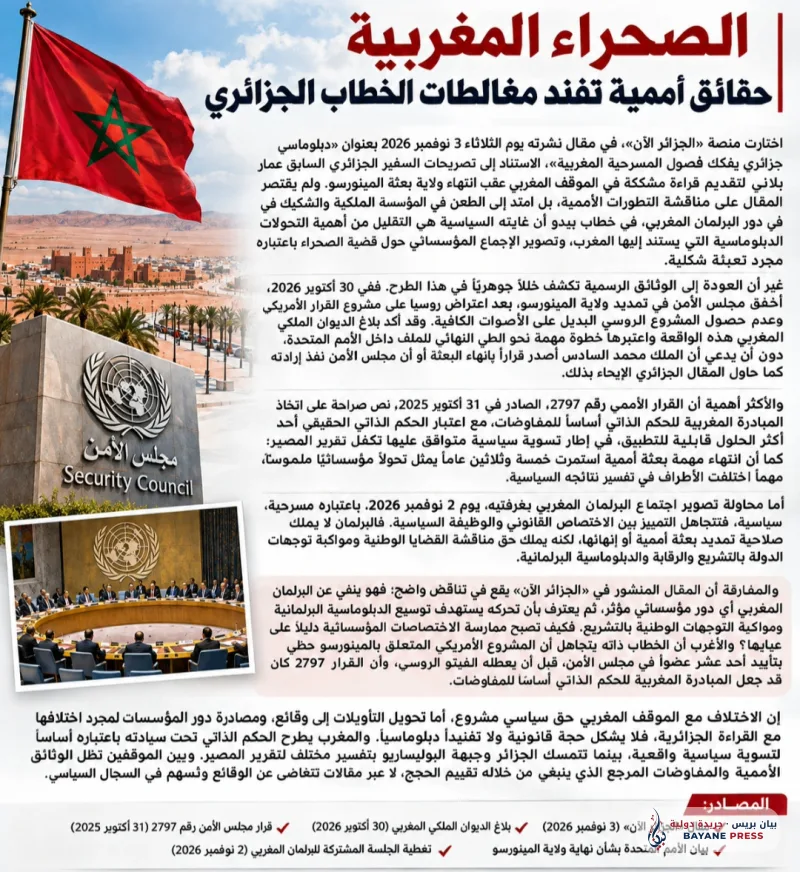
It is striking that this coverage comes at a stage when the Moroccan Sahara file has witnessed significant diplomatic developments, especially after UN Security Council Resolution 2797, issued in October 2025, which granted the Moroccan autonomy proposal a central place in the political negotiation process. This development has reinforced the importance of the Moroccan initiative proposed since 2007, at a time when Rabat continues to work on expanding international support for its position and consolidating the presence of its southern provinces within development, investment, and infrastructure projects.
As for the developments witnessed by the MINURSO mission file at the end of October 2026, after the stalling of its mandate renewal within the Security Council, they have reopened the debate on the future of the UN process, without implying the resolution of all political and legal aspects of the conflict. Therefore, reducing these shifts to Polisario's messages and accusations obscures an important part of the diplomatic landscape and provides the reader with a partial treatment of a file that requires an understanding of the positions of various parties and the relevant international resolutions.
This media interest has not stopped at diplomatic files but has extended to Moroccan internal affairs, after the Algerian Press Agency published a report on demolition and urban redevelopment operations in Rabat, accompanied by accusations related to real estate dealings and residents' rights. In principle, urban projects and the legal or social issues accompanying them remain legitimate topics for journalistic coverage and public accountability; however, using them to issue broad political judgments, without independent verification of all accusations, turns the issue from a debate about citizens' rights into part of a media confrontation.
Morocco, like various countries, experiences debates regarding public policies, urban projects, and social reforms, which are issues addressed by national media, specialized institutions, and civil society actors. There is nothing in the existence of these debates that justifies turning them into general judgments about the Moroccan state and its institutions, because journalistic responsibility requires placing facts in their context and distinguishing between the legitimate demands of those affected and accusations that require proof.
On another level, the newspaper "Khabar Press" chose to address the Moroccan Royal institution in a style characterized by sharpness, through a headline evoking the image of a "spider's web," before moving on to accusations related to politics and diplomacy. Here, the discussion goes beyond mere disagreement between states to raise a question about the limits of media criticism, and the appropriateness of using hurtful analogies and preconceived notions in addressing political issues. Disagreement with the Kingdom's positions does not give any media institution a justification to replace objective analysis with the language of attack, just as diplomatic competition should not turn into an insult to national institutions.
If these headlines seem separate in their topics, what unites them is the presence of Morocco as a recurring axis for negative coverage, whether it concerns the Moroccan Sahara, internal management, or constitutional institutions. Their coincidence alone is not enough to prove direct coordination between the newspapers concerned, but it raises questions about editorial priorities and the extent to which media work is influenced by the ongoing political dispute between Rabat and Algiers.
The importance of these questions increases given that the Moroccan-Algerian dispute is considered one of the longest political rivalries between two Arab and Muslim countries in the modern era; since the Sand War in 1963, the tension has spanned sixty-three years, interspersed with periods of rapprochement and reconciliation that did not end the roots of the dispute.
However, the persistence of this tension does not alone explain the transformation of some Moroccan news into recurring material for media escalation. Journalism is supposed to maintain a professional distance from diplomatic disputes and to distinguish between what political entities say and what independent facts prove. When accusations precede evidence and sensational headlines outweigh essential details, the reader is faced with a selective narrative that does not help them form an accurate picture of events.
What is even more thought-provoking is that this intense interest in Morocco coincides with economic, social, and developmental challenges facing the entire Maghreb region. The citizen in Algeria, like the citizen in Morocco, needs a press that follows issues of employment, purchasing power, education, health, investment, and public services, and monitors government policies and discusses their results. This does not mean neglecting foreign news, but rather achieving a balance between following the neighbor and fulfilling the media responsibility toward the society to which the newspaper is addressed.
Furthermore, the constant focus on disputes may contribute to consolidating an unbalanced mental image of Morocco among part of the Algerian public, especially when news related to economic development, industrial projects, renewable energy, infrastructure, and diplomatic initiatives is absent. A fair media image of any country is not based on displaying achievements alone, nor on constantly recalling difficulties, but on presenting various facts without selection that serves a preconceived political position.
It is also important to distinguish between some Algerian media discourses and the Algerian people themselves, who share deep historical, cultural, social, and human ties with Moroccans. Disputes between states should not turn into judgments on peoples, just as criticizing media coverage does not mean rejecting the right of the Algerian press to follow Moroccan affairs or question its policies, but rather demanding that this be done according to the rules of verification, balance, and respect for facts.
The strength and status of Morocco do not depend on what some Algerian media outlets publish, but are based on its institutions, development choices, diplomatic presence, and its ability to continue reform, investment, and strengthening stability. Therefore, the most effective response to selective media treatments does not lie in being drawn into exchanging accusations, but in presenting facts accurately, highlighting achievements without exaggeration, and addressing internal challenges with responsibility and transparency.
The paradox remains that Morocco and Algeria, despite the history, geography, and social ties that unite them, continue to live the repercussions of a long political rupture, while the region's need for economic cooperation, security coordination, and benefiting from their common potential increases. In such a climate, the role of the media becomes extremely sensitive, because it can contribute to bringing points of view closer, just as it can deepen the psychological distances between societies when the discourse of confrontation prevails over the requirements of the profession.
Comments (0)
No comments yet. Be the first to react!